
4 Confidence Sapping Words To Throw In The Bin And What To Say Instead


Words have power!
Have you ever paid attention to how you speak to yourself? The words that pop up in your head or the way you describe yourself when you're around other people?
In today's world of social media and technology, where you constantly feel the need to ‘prove’ yourself, it's easy to get caught up in a negative feedback loop. You start to doubt yourself and try to be something you're not.
This often shows up in the words that you use to describe yourself or your ability to complete tasks.
Spend a day and really pay attention to the way that you speak to yourself. Are you your own cheerleader, or do you put yourself down? If it's the latter, ask yourself, would you speak like that to a friend? Of course not, so why speak like to yourself?
In this post, let’s explore some of the most common confidence-sapping words and discover alternatives that will boost your self-confidence and fire up your inner cheerleader.
Word #1 - Should

This word truly sucks!
Should is a word that is dripping with fear. It reeks of following the crowd.
It is everywhere––on social media and in all aspects of life! We're surrounded by so-called experts who claim to have foolproof methods for passing exams; influencers making millions lounging on hammocks in Skegness; and celebrities who became famous for losing loads of weight, posting content or eating peanuts!
And you're bombarded by ‘shoulds’ constantly––through ads, content, and peer pressure!
Have you ever said something like this…"I should study more,”"I should stop eating chocolate,” or “I should have more friends!” I bet you have!
We think we should be doing more or less because ‘should’ is like a mosquito––always buzzing around, pointing out everything that's wrong or could be better!
However, when you stop and review the ‘shoulds’ a good question to ask is: Do I actually want to do this? Does this help me? Would this make me happy or help to reach a goal?
In most cases, the answer is a resounding no! If the answer is no, block out the noise and focus on doing the things that truly help you and make you happy.
I hear students ‘shoulding’ themselves all the time during exam season. They compare themselves to other students and constantly see content on social media telling them what they ‘should’ be doing to get top grades.
When I hear this, I always encourage them to ask the questions above and focus on the actions that work for them––not what work for other people!
Word #2 - Try

I live by the words of a wise old green alien: you take action or you don't, there is no in-between.
When I hear people saying that 'I will try' their voice always becomes quieter and their body language becomes more defensive. ‘Try’ is a word that shouts out that you don't believe in yourself or abilities, or that you don't really want to take that action. Either way there is a lot of fear at play as you are not sure of the result and whether the effort will be worth it.
But, uncertainty is also full of opportunities!
And, there is only one way to find out if something will work or not and that is by doing it!
Instead of ‘try’ make things more playful or focused in nature by using words such as ‘willing,’ ‘focus on,’ ‘let’s give it a go,’ or ‘commit”. Using these words is much more empowering and offers more possibilities.
I commit to doing five flashcards for my Shakespeare exam
I am focusing on improving my Theme 2 knowledge this week
Let’s give this new revision technique a go for one week
I am willing to work harder on my notes this week
These examples show a commitment to action and confidence comes from repeated actions. Take the first step and then go from there.
Life is all trial and error and if you really want to make a change...don't try....DO IT and learn all the lessons that show up along the way.
Word #3 - Can't

'Can't' is such a limiting word!
I've heard so many students tell me that they ‘can’t’ do things––like speak English, do presentations, pass an exam, get into a football team, or solve a problem. And, all those students have one thing in common: They did the things they thought they couldn’t do and totally smashed their goals!
Can you think of times when you told yourself that you couldn’t do something, but then succeeded? It could be something big or small!
Over the years, I've told myself I can’t pass exams, go on big rollercoasters, get a girlfriend, travel abroad or run a 10k race in my 40s…and I have done all those things!
Next time you hear yourself say ‘I can’t,’ ask yourself: Where is the evidence? If that question reveals gaps in your knowledge and skills, then you can do something about that, can’t you?
'You can do anything you set your mind to' may sound like a cliché, but it's absolutely true! There are always solutions, and if you want something to happen, you will make it happen.
Take the time to visualise your goals and then GO and MAKE them happen. It might feel comfortable stepping out of your comfort zone, but keep telling yourself that 'I HAVE GOT THIS' and watch the fears fall away.
Word #4 - Never
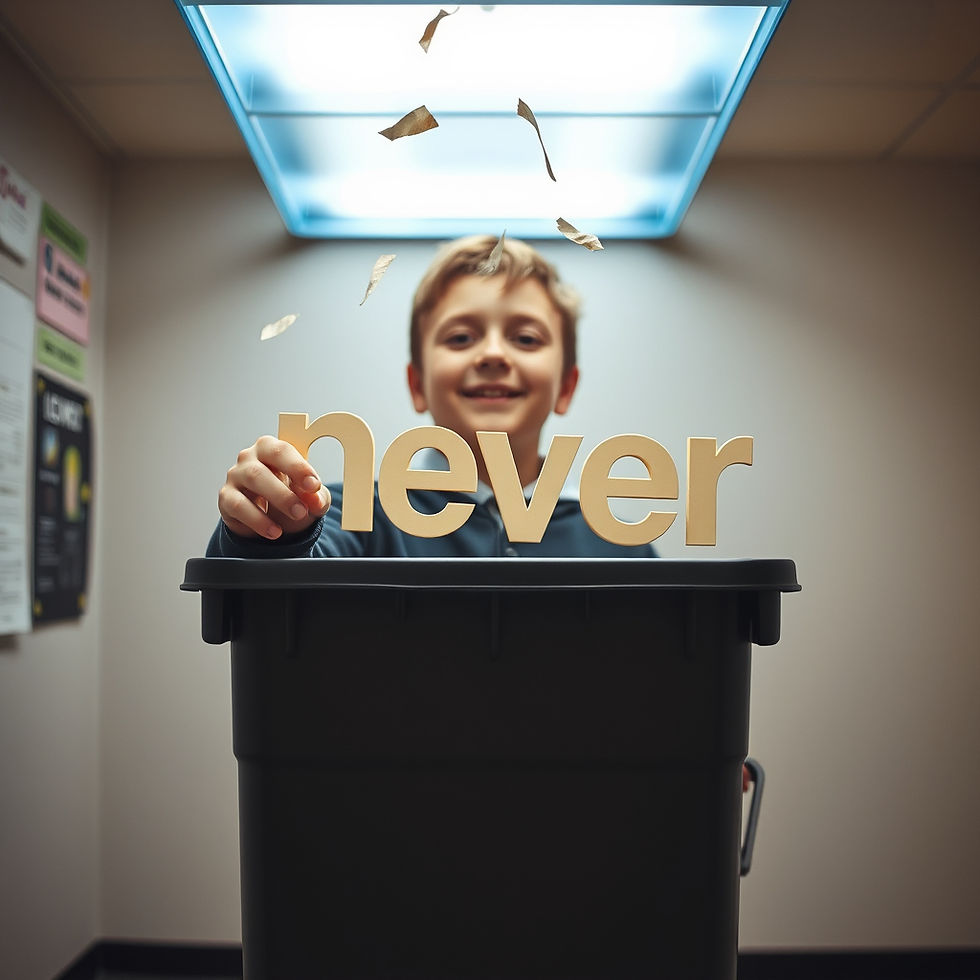
If you ever catch yourself saying "I will never," ask yourself: Where is your crystal ball?
Can you see the future? If so, can you tell me the lottery numbers for next week!
Here are a few things I have heard students say in the past:
"I will never pass my English GCSE"
"I will never get the grades I need for university"
"I will never get a job"
Why not? Where is the evidence?
You have all the tools to achieve any of your dreams. Look around you––the world is full of stories of people that refused to accept 'never' as a possibility. They tapped into their resilience and took actions until they reached their goals.
If you catch yourself saying "I will never..." replace it with "I haven't done it yet". Adding the word 'yet' to your sentences is a powerful way to focus your mind, remind yourself of your goals so you can focus on the actions needed to make them happen.
I haven't got an B yet, but I am doing all I can to make it happen.
I don't haven’t got a job yet, but I am taking actions to make it happen.
Much more empowering, isn't it?
Focus On Your Strengths To Build Confidence

Learn to become your number one cheerleader, and you'll boost your self-belief.
As you can see words have power. Changing the words you use can have a massively powerful impact on your confidence, self-belief, and the actions that you take. It opens your mind to opportunities rather than looking for threats.
Lean into your strengths and take steps to turn any weaknesses into strengths. There are always solutions, and you can do amazing things! So hop on board the life train and enjoy the adventure!
Where will it take you?


Comments